
.svg)

The founder playbook expired. Here’s the rewrite for 2026

.svg)
.svg)
Why clarity, positioning, and revenue-aligned GTM systems now outperform speed, volume, and growth hacks.
TL;DR
The old founder-led SaaS playbook doesn’t work in 2026. Buyers are sharper, cycles are messier, and AI erased the edge of speed and volume. The companies that win now aren’t louder, they’re clearer. They operate with tight positioning, narrative discipline, revenue alignment, and GTM systems built to learn, not guess. Growth in 2026 comes from clarity and operational precision. Not hacks, noise, or activity.
Key themes
- Why the old founder-led SaaS playbook no longer works
- How clarity and narrative become competitive advantages
- Insight-driven content vs. volume-driven content
- Why revenue alignment is now mandatory
- AI as a multiplier of strategy, not a replacement for it
- What the fastest-growing SaaS teams are doing differently
If you’re a SaaS founder, or leading the marketing and GTM team behind one, here’s one uncomfortable truth heading into 2026:
The old founder playbook doesn’t work anymore.
Not in this economy.
Not with these buyers.
Not with this level of noise.
Demand has changed. Attention has changed. AI changed the speed of competition. So, what does this mean for your growth?
In 2026 (and beyond), the companies that win won’t be the loudest. They’ll be the ones with clarity, systems, and a GTM motion built for how people actually evaluate software today.
Here’s the thing: This isn’t about being “more innovative” or "thinking differently." This is about updating the operating model that got most SaaS companies through the last decade—but won’t get them through the next.
So let’s rewrite the founder playbook for 2026 using strategy, simplicity, and a little tough love.
The old playbook: Loud, fast, and painfully shallow
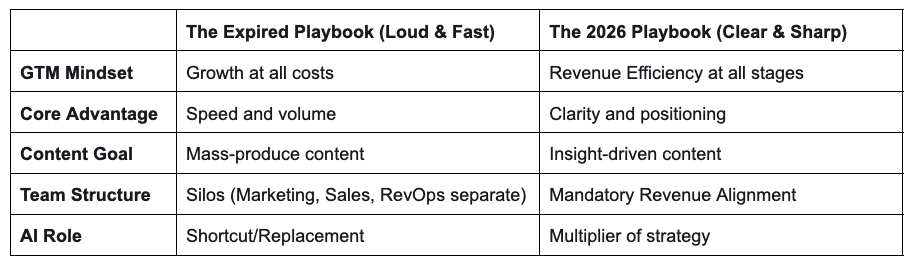
The old founder-led SaaS playbook doesn't work in 2026. This outdated strategy was characterized by loud, fast, and shallow execution, including mass-producing content and relying on cheap capital. It is now obsolete because buyers are sharper, cycles are messier, and AI has erased the edge of speed and volume.
For the last decade, most SaaS companies grew with a version of this script:
- Build something interesting
- Hire a few SDRs
- Spin up paid ads
- Mass-produce content
- Add a “funnel” slide to the board deck
- Raise
- Repeat
The honest truth? It worked. Not because it was brilliant, but because demand was high, capital was cheap, and buyers weren’t drowning in generic AI-generated pitches.
But today, the cracks are impossible to ignore:
- Buyers research harder and expect clarity immediately.
- Buying groups are bigger, cycles longer, and patience lower.
- AI gave everyone the ability to create content, but not clarity.
- Founder-led sales is still powerful, but only when supported by a real GTM engine.
The old playbook wasn’t “bad.” It’s just outdated.
The rewrite: Clarity first, speed second
Ready for the new foundation?
The modern GTM foundation you need in 2026 prioritizes clarity, systems, and operational precision over chasing speed and hacks. The key shift? Moving from managing a linear funnel to managing the conditions that create demand and accelerate decisions.
Here’s the foundation fast-growing SaaS teams are already using. Not growth hacks. Not AI shortcuts masquerading as strategy. We’re talking about actual systems that scale.
#1 Positioning is the new unfair advantage.
If you’re confused, your buyers are gone in three seconds flat. Positioning is the new unfair advantage because B2B buyers have a 3–5 second tolerance for confusion. After that, they’re clicking elsewhere.
If your positioning can’t answer:
- What problem do you solve?
- Who do you solve it for?
- And why you, not the 47 alternatives?
…your growth ceiling drops immediately.
Most companies don’t lose deals because of price or timing. They lose because buyers can’t figure out what the company actually does, or whether it matters.
Reality Check: Clarity converts. Jargon doesn’t. If they’re confused, they’re gone.
#2 The funnel isn’t linear anymore. Stop forcing it to be.
The B2B funnel is no longer linear because leads bounce between multiple, non-sequential channels—a messy web of research points—meaning founders who win must build GTM systems that influence buyers across all entry points.
Let’s be honest, your buyers don't "move" down anything. They are researching across (all before ever talking to you!):
- Google searches
- AI assistants (ChatGPT, Gemini, Claude, Perplexity)
- Your websites
- Competitor websites
- Communities (Slack, Reddit, Discord)
- Analyst pages
- Customer reviews
- YouTube
- Social proof (podcasts, interviews, demos, webinars)
This is not a funnel. It’s a messy web. Founders who win in 2026 stop obsessing over linear stages and start building systems that influence buyers across multiple entry points.
Reality Check: Funnels don’t flow. Buyers zig-zag. Your GTM needs to follow them.
#3 Content isn’t a volume game. It’s an insight game.
AI has made content cheap, but it hasn't made it good—everyone can create it, but very few can create insight. Content must serve as strategy, clarifying the problem and making your solution inevitable, rather than just generating noise.
Founders need content engines that do three things:
- Clarify the problem
- Show the cost of inaction
- Make your solution inevitable
This is what creates trust. Not frequency. Not volume. Not posting every day.
Reality Check: Content isn’t “stuff you publish.” It’s your strategy in public.
Let’s be blunt: AI can write 100 posts. Only insight earns trust.
#4 Revenue alignment isn’t optional anymore.
You can't afford to run three separate companies. Revenue alignment is now mandatory because Marketing, Sales, and RevOps must speak one language. Operating these three functions in silos makes marketing expensive, sales slow, and the founder the default bridge (translator, referee, chief firefighter), often leading to burnout.
This creates slow cycles, expensive acquisition, and constant internal tension. High-performing companies operate differently: They build one revenue system with one narrative, one data model, and one definition of success.
Reality Check: Three siloed teams = three conflicting realities. Buyers feel that disconnect instantly. Revenue teams win when they speak one language.
#5 AI won’t save your GTM. But it will scale it.
If your GTM is broken, AI will only break it faster. AI won’t save a broken GTM but will scale a strong one by acting as a multiplier of existing clarity. AI is extraordinary for research, message testing, and content acceleration, but it cannot fix a weak positioning, unclear ICPs, misaligned teams, or random acts of marketing.
Reality Check: AI doesn’t fix GTM problems. It exposes them faster. It scales what you already are: clear or chaotic.
The new 2026 founder playbook: What actually works now
The new GTM Playbook is built on clarity, narrative discipline, revenue alignment, and GTM systems designed to learn, not guess. The goal is to grow sharper, not louder, by building predictable, repeatable systems behind the scenes
This is the part nobody says out loud, but every fast-growing SaaS team is doing behind the scenes.
1. Nail the narrative before you scale the motion
Before you hire pipeline teams, spend on paid, or invest in thought leadership, you need to stop building on sand. You need:
- a tight, differentiated positioning statement
- a simple narrative the whole business can repeat
- a clearly defined ICP with real disqualifiers
- 3–5 value pillars tied directly to outcomes
If you can’t articulate these, nothing else you do will be consistent or predictable.
2. Build a content engine that works like a lab, not a library
You don’t need a content factory. You need a content system that learns. Think:
- insight-driven content
- narrative-led messaging
- AI-assisted creation
- testing loops built into each asset
This is how you get compounding returns. Not a pile of blog posts no one reads.
3. Replace random acts of marketing with a repeatable GTM system
In 2026, companies win by building a machine that can be tuned, not a series of one-off projects. This means:
- a predictable top-of-funnel motion
- a mid-funnel program that educates, not pressures
- a sales process aligned to how buyers actually buy
- post-sale expansion baked into the model
Most founders don’t need more ideas. They need clarity and consistency.
4. Prioritize revenue efficiency, not just growth
Growth at all costs is gone. Efficiency at all stages is in. That means:
- shorter cycles
- cleaner handoffs
- cleaner data
- less tool bloat
- attribution that actually makes sense
High-efficiency teams outpace high-activity teams every time.
5. Use AI as a strategic advantage, not a shortcut
AI helps you scale messaging, testing, and execution… after you’ve nailed the strategy. With a strong narrative, AI becomes your amplifying force. With a weak one, it becomes a megaphone for confusion.
Use AI to scale strategy, not replace it.
What this means for founders in 2026
2026 isn’t a reset. It’s a recalibration.
The founders who win will:
- communicate simply
- operate with precision
- measure what matters
- build systems, not silos
- treat clarity as a revenue driver
- use AI as leverage, not a stunt
The ones who don’t will spend another year fighting pipeline inconsistency and blaming marketing or sales for what is ultimately a strategy problem.
Let’s be even clearer: You don’t need to grow louder.
You need to grow sharper. And that comes from focus, narrative discipline, and operational precision.
FAQs: What every SaaS team asks in 2026
- Why doesn’t the old founder-led playbook work anymore?
Because buyers are more informed, markets are saturated, and AI erased the advantage of speed and volume. Clarity beats hustle now. - What is a modern SaaS GTM strategy in 2026?
A GTM strategy built on positioning, revenue alignment, narrative discipline, and systems that learn. Not a funnel built on guesswork. - How should founders use AI in GTM?
As a multiplier for clarity, messaging, and research. Not as a shortcut for strategy. - Why is revenue alignment mandatory?
Because buyers don’t experience Marketing, Sales, and RevOps separately. Misalignment creates friction, longer cycles, and lost deals. - What’s the fastest way for a SaaS startup to fix its GTM?
Start with positioning → narrative → ICP clarity → revenue alignment → consistent content engine. - How do I know if our GTM is outdated?
If buyers seem confused, cycles are slow, messaging feels random, or the founder is doing the lifting, your GTM is outdated.
A founder-friendly call to action
If your GTM feels messy, inconsistent, or overly dependent on you, it’s not a sign you need to “try more things.” It’s a sign your playbook needs a rewrite.
That’s what we do at Funnel Vision Labs: We bring clarity to messy funnels. Even when you can’t see what’s broken.
We map the bottlenecks, fix the narrative, and build the systems that turn signal into pipeline and pipeline into revenue.
The old playbook expired. It’s time to build the one that actually works.
Related Articles




Ready to fill your funnel?
Stop wasting budget on siloed tactics. Get CMO-level strategy and execution, built to scale.