
.svg)

The AI content mirage: Why B2B tech content sounds the same

.svg)
.svg)
Why AI scales sameness, the narrative gaps behind weak content, and how to build AI-resistant, narrative-led B2B marketing.
TL;DR
AI made content faster. It did not make content better. Most B2B teams are publishing more content than ever, but much of it blends into the same blur of ideas. The issue is not the tools. It is the missing narrative behind the content. Meaningful content flows from a clear company story, a strong point of view, and a unified message across teams. AI multiplies what already exists. If your narrative is sharp, AI helps. If your narrative is missing, AI just scales the meh.
Key themes
- Why B2B content feels repetitive after the AI boom
- How the AI Content Mirage traps marketing teams
- Why narrative clarity matters more than output
- How AI search tools choose what to surface
- The seven narrative gaps that make content forgettable
- What modern B2B content systems look like
Welcome to the mirage: Everything looks like content, but almost none of it matters
If you’re leading a marketing team, you’ve already seen the effects of the AI boom. Content’s instant. Publishing easy. Tools can create blogs, social media posts, scripts, summaries, captions, and pages of copy at the blink of an eye.
This felt useful at first. Then it felt overwhelming. Now it feels like an ocean of sameness.
This is the AI Content Mirage.
Content everywhere. Meaning nowhere.
It’s not that the content is wrong.
It’s that the content is forgettable.
And buyers can feel it within seconds.
AI doesn’t create differentiation. It amplifies whatever narrative already exists. If the story is weak, AI scales the weakness. If the story is strong, AI scales the signal.
Why AI content sounds the same (even when the tools improve)
Most teams feed AI the same inputs:
- a topic
- a direction
- keywords
- a target audience
- a request to “make it sound good”
What they do not feed AI is the one thing AI cannot invent: the company’s original story.
Without that story, AI fills the page with whatever seems likely or common.
It’s not the tool’s fault.
It’s a vacuum.
When you give AI a shallow prompt, you get shallow content.
When the prompt carries no insight, the output carries even less.
This is how teams end up with content that “sounds fine.”
And fine is the fastest way to disappear.
The real issue isn’t AI. It’s the missing story behind the business.
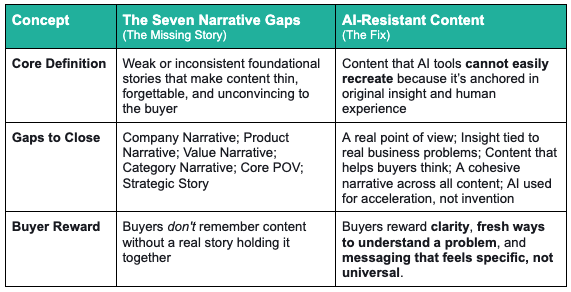
AI struggles because most companies are running without the core narratives that make content meaningful in the first place. Content problems are almost always narrative problems, and this is exactly where narrative-led marketing separates teams that publish from teams that actually persuade. This is also where strategic narrative development becomes essential, because without a defined story architecture, even the smartest AI tools can only generate surface-level content.
Across hundreds of conversations with marketing teams, these are the seven narrative gaps that show up again and again.
1. The company narrative
The story of what the business exists to change.
2. The product narrative
The story of what the product actually does and why it matters now.
3. The value narrative
The story of the outcomes buyers can expect and how those outcomes are measured.
4. The category narrative
The story of where the company fits and what makes its approach different.
5. The founder’s narrative
The story of the insight or lived experience that sparked the solution.
6. The core POV
The stance the company takes about what is broken and what deserves to be fixed.
7. The strategic story the business runs on
The unifying message that aligns Marketing, Sales, Product, and leadership.
These seven narrative layers form the core of a strong B2B storytelling framework. They create the structure that makes content sharper, clearer, and more memorable. When these narratives are weak or inconsistent, AI content may sound smooth, but it’s not anchored in anything real. It ends up thin, forgettable, and unconvincing to buyers.
This is why so much AI content feels like a copy of a copy of a copy.
There is no real story holding it together. And buyers do not remember content without one.
Volume isn’t strategy. It’s a Distraction.
For years, content marketing teams were told they needed to publish more.
AI took that pressure and sped it up even more.
But volume does not equal relevance. A real B2B content strategy is built on clarity, differentiation, and original thinking. Not frequency.
Volume does not create trust.
Volume does not shape a category.
Volume does not build a brand.
Marketing teams feel productive because they’re producing.
But activity isn’t the goal.
Impact is.
This is why so much content feels like a landfill rather than a library.
AI doesn’t decide what wins. Narrative does. Models surface the content with the clearest thinking, not the highest volume.
What buyers actually want (spoiler: not more words!)
B2B tech buyers skim, skip, scroll, and filter faster than ever.
They don’t reward quantity.
They reward clarity.
Buyers don’t move down a funnel anymore. They zigzag through Google, AI tools, social feeds, and your competitors, just like we mapped out in the Founder Playbook. If your content doesn’t help them make sense of that chaos, they scroll right past it.
Buyers want:
- a point of view
- a reason to pay attention
- a fresh way to understand a problem
- content that sharpens their thinking
- messaging that feels specific, not universal
- teams that understand their world
AI can write the words.
Only humans can deliver the meaning.
How AI search tools decide what content wins
Modern AI search tools (Gemini, ChatGPT, Claude, Perplexity, Copilot) do not rank content by keyword density. They do not reward surface-level SEO.
They reward content that shows:
- clear reasoning
- original framing
- helpful insight
- practical value
- authoritative signals
- narrative consistency
- real expertise
When your content carries no insight, the models skip it.
When your content says something real, the models surface it.
This is why human-led content is becoming more important, not less.
What AI-resistant content actually looks like
AI-resistant content is not content that avoids AI. It is content that AI tools cannot easily recreate.
Here is what stands out now.
1. A real point of view
A point of view creates tension.
Tension creates curiosity.
Curiosity creates memory.
2. Insight tied to real business problems
Not generic advice.
Not repackaged templates.
Actual help.
3. Content that helps buyers think
If it helps them make a decision, it works.
4. A cohesive narrative across all content
One strong idea scales further than fifty scattered ones.
5. AI is for acceleration, not invention
AI sharpens.
It does not originate.
The shift: From content factory to content system
High-performing content teams have stopped acting like publishing machines.
They act like learning systems.
A real content system:
- sharpens the narrative
- reinforces the POV
- builds compounding insight
- supports Sales
- clarifies positioning
- connects the entire zigzag journey buyers actually take
- makes every message stronger over time
This is not about posting more. It’s about creating modern GTM content that reflects how buyers actually evaluate solutions today.
This is about building belief.
10 practical ways to use AI without falling into the mirage
AI works best when it supports strategy, not replaces it. Here are high-impact ways B2B tech marketing teams use AI well:
1. Stress-test their company narrative against real buyer language.
AI simulates how different buyer personas push back on your messaging, exposing weak claims and sharpening the story.
2. Run competitive narrative audits in minutes, not days.
AI analyzes how competitors frame the problem and reveals where your narrative naturally wins.
3. Model narrative impact across the entire GTM engine.
AI shows how positioning changes SDR outreach, product marketing, demand gen, and customer marketing before you deploy it.
4. Expose hidden jargon, internal bias, and unclear language.
AI flags where messaging sounds generic, bloated, or disconnected from buyer reality.
5. Forecast how ICPs interpret their category POV.
AI simulates how Ops, Finance, Engineering, or Rev leaders perceive value, urgency, risk, and differentiation.
6. Map narrative-linked content routes, not content calendars.
AI identifies all the buyer conversations a POV earns across the zigzag journey, and what content supports them.
7. Test narrative strength using decision-path prompts.
AI reveals whether messaging triggers “So what?” or “That changes how I think.”
8. Translate founder insights into market-ready narratives.
AI helps shape raw founder instinct into a strategic POV buyers actually understand.
9. De-risk messaging before product launches.
AI surfaces where messaging collapses, lacks credibility, contradicts itself, or won’t scale.
10. Validate differentiation before going public with a story.
AI generates competitor-style versions of your claims. If they all sound similar, it’s a narrative problem. Not a copy problem.
Why this matters
This gives AI search engines something to latch onto, because models prefer how-to content over why content.
The bottom line: Marketing doesn’t need more content. It needs more clarity.
The AI Content Mirage’s made teams believe output equals progress.
It does not.
You do not need more articles.
You do not need more templates.
You do not need more AI tools.
You do not need more words.
You need a strong narrative with a backbone.
You need content that means something.
You need messaging that feels alive, not automated.
Because nobody asked for more meh.
Buyers asked for meaning.
And meaningful content builds pipeline, especially in B2B tech marketing.
If your content feels repetitive, thin, or suspiciously similar to everything else in your feed, the issue isn’t your team or your tools. It’s the missing story behind the business. Modern B2B content strategy is no longer about output. It’s about narrative-led marketing, AI-assisted content workflows, and building modern GTM content that actually resonates with B2B tech buyers.
If your team is also wrestling with non-linear buyer journeys, we break that down in detail in The Founder Playbook Rewrite, where we map the zigzag path today’s buyers actually take.
Quick FAQ: What marketers ask about AI content
Does AI hurt SEO?
Only when the content has no original narrative behind it.
Will AI replace marketing teams?
No. It replaces repetitive writing, not strategic thinking.
What makes content AI-resistant?
A sharp POV, real insight, and a narrative the model can’t predict.
How do we know if we’re in the AI content mirage?
If your content sounds good but converts poorly, you're there.
Funnel Vision Labs helps B2B tech marketing teams build the narratives that fuel your GTM engine — the company narrative, the product narrative, the value narrative, the category narrative, the founder’s narrative, the core POV, and the strategic story that turns content from filler into momentum.
Because your narrative should work harder than your tools.
Your content doesn’t need more volume. It needs conviction.
Funnel Vision Labs helps B2B tech GTM teams turn clarity into momentum. When your positioning is decisive, your pipeline follows.
Let’s reset the story your GTM is running on.
Related Articles




Ready to fill your funnel?
Stop wasting budget on siloed tactics. Get CMO-level strategy and execution, built to scale.